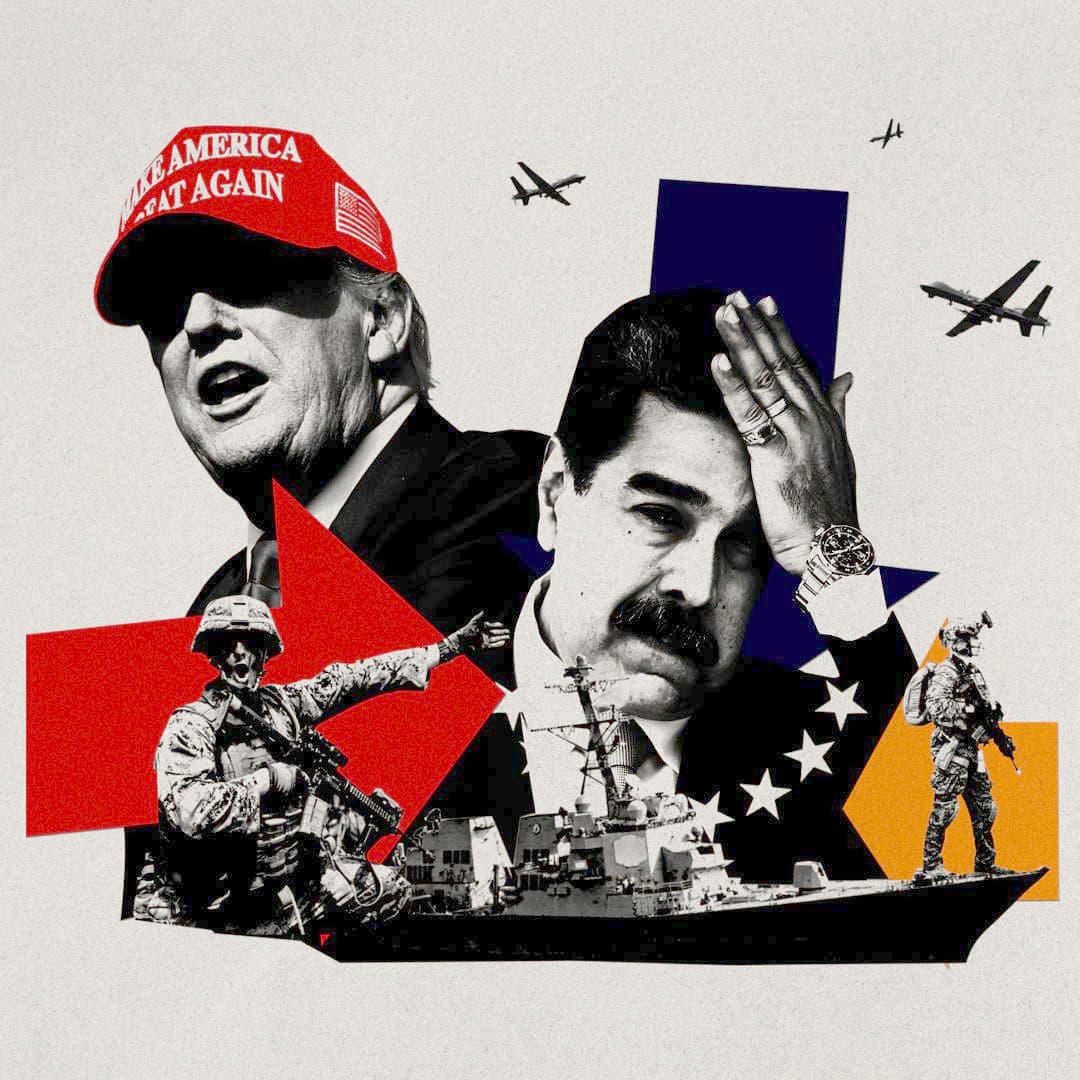
For fourteen months, María Corina Machado has been in hiding. The woman who orchestrated Venezuela’s opposition to a landslide victory in the July 2024 election, only to watch Nicolás Maduro claim the presidency anyway, now communicates through encrypted messages and clandestine appearances, one step ahead of the security forces hunting her. In October, from an undisclosed location she accepted the Nobel Peace Prize.
She dedicated it to Donald Trump.
Machado has cultivated the Trump administration as her principal external ally. Secretary of State Marco Rubio, who also serves as the National Security Adviser, has made unseating Maduro his signature project. In November, the administration designated Maduro the head of a “Foreign Terrorist Organisation”, a legal framework some interpret as laying the groundwork for military action. By late November, the Pentagon had positioned approximately 15,000 troops in the Caribbean, including an amphibious ready group and carrier strike elements. Rubio has publicly compared Maduro to Manuel Noriega, the Panamanian dictator whom U.S. forces removed in five days during Operation Just Cause in 1989.
The analogy is seductive. Noriega faced drug trafficking indictments. He ran a corrupt autocracy that had stolen an election. And he fell quickly, cleanly, to overwhelming American force. As policymakers float notions of a “decapitation strike”, the Noriega playbook offers a comforting precedent: regime change as minor surgery.
But the comparison reveals more about the wishes of its advocates than the realities they would confront. Panama in 1989 was a policing action in a country where the United States had maintained a permanent military garrison for eighty-five years, against an enemy with no air force, no external allies, and fewer combat-ready troops than a single U.S. Army division. Venezuela is a nation twice the size of Iraq, defended by Russian air defence systems and Cuban-trained intelligence services, governed by a regime that has spent two decades preparing for exactly this scenario.
“Venezuela is not Panama. Treating it as such would not produce a quick victory. It would produce a war.”
Panama, 1989
When President George H.W. Bush ordered Operation Just Cause, the invasion had already half-happened. Approximately 13,000 U.S. troops were garrisoned inside Panama, a legacy of the Canal Zone treaties that had given the American military a permanent presence since 1903. SOUTHCOM headquarters sat on Panamanian soil. The U.S. Army ran a jungle warfare school at Fort Sherman. American officers had Panamanian wives, Panamanian informants, and eighty-five years of accumulated intelligence on every facility they would need to seize.
The operation itself was part invasion, part commute. On December 20, 1989, an additional 14,000 soldiers flew in to join the forces already in place. Twenty-four targets were hit simultaneously, severing the command-and-control of the Panamanian Defence Forces (PDF) within hours. Major combat ended in five days. Noriega surrendered by January 3rd.
The PDF never stood a chance. Its 12,800 personnel included perhaps 4,000 combat-ready soldiers. It had no air force. It had no tanks. It had no surface-to-air missiles, no radar network, no external allies willing to intervene. Command was centralised in a single building, the Comandancia in Panama City. When U.S. Rangers took the Comandancia, the PDF’s spine snapped, and resistance collapsed across the country.
The geopolitical context was equally forgiving. The Soviet Union was months from collapse, consumed by its own internal crises and uninterested in defending a Central American strongman. No great power would challenge Washington over Panama. And critically, the U.S. had a government ready to install. Guillermo Endara had won Panama’s presidential election in May 1989, only for Noriega to annul the results. On the night of the invasion, Endara was sworn in on a U.S. military base, transforming the operation from regime change into democratic restoration. By morning, Panama had a civilian president with an internationally recognised electoral mandate.
The structural conditions could hardly have been more favourable. A military that had trained on the actual terrain for decades. An enemy with no answer to American airpower. A geopolitical environment in which no external power would intervene. And a legitimate government waiting to assume control the moment Noriega fell. Operation Just Cause succeeded because these conditions aligned. The question for Venezuela is whether any of them exist today.
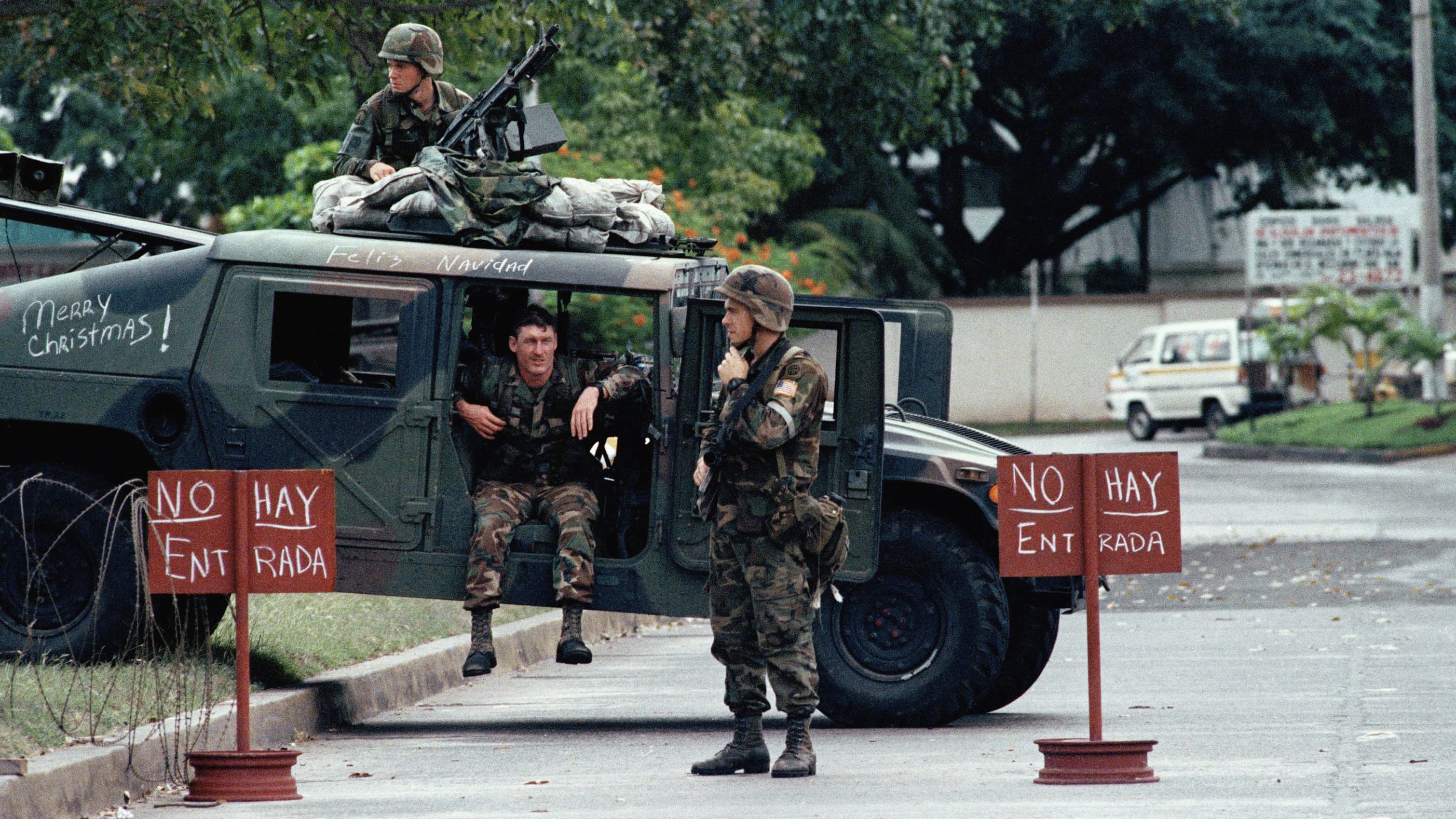
Venezuela: The Inverse Case
Venezuela in 2025 fails every condition that made Panama possible.
The United States has no troops on Venezuelan soil, no bases, no intelligence infrastructure cultivated over generations. The Venezuelan military, whatever its limitations, fields Russian air defence systems capable of contesting American aircraft and anti-ship missiles capable of threatening American vessels. The state security apparatus has been rebuilt under Cuban guidance to survive exactly the kind of decapitation strike that collapsed the PDF in hours. And beyond the conventional military, the Maduro government commands a network of armed loyalists embedded in civilian neighbourhoods, trained and ideologically prepared for prolonged resistance.
What follows is an assessment of each layer: the geography that any invasion force would have to cross, the weapons that would contest its approach, the intelligence architecture designed to ensure leadership survival, and the asymmetric forces waiting on the other side of any military victory. Taken individually, each represents a serious obstacle. Taken together, they describe a trap.
Scale, terrain, the coastal approach to Caracas
Venezuela covers 912,050 square kilometers. It is twelve times the size of Panama and twice the size of Iraq. The 26,000 troops that overwhelmed Noriega’s forces would be stretched impossibly thin across a territory larger than France and Germany combined.
But scale alone underestimates the problem. The terrain actively favours defenders at every chokepoint an invasion force would need to pass.
Caracas is a natural fortress. The city sits in a mountain valley about 900 meters above sea level, separated from the Caribbean coast by the Cordillera de la Costa, a range that rises to nearly 3,000 meters in barely fifteen kilometers. The main approach from the sea is a single artery, the Caracas-La Guaira highway, which connects the city to its principal airport and seaport.
The highway is a killbox. The road traverses two major tunnels, the longest stretching nearly two kilometers through the mountain. Three viaducts carry it across ravines. The largest of these collapsed from geological instability in 2006 and took years to rebuild. A small defending force could demolish tunnels or bridges and sever the only direct route from coast to capital. What remains is an old mountain road with twelve percent grades and hairpin turns unsuitable for armoured vehicles.
Assume U.S. forces make it to Caracas anyway. What then? The capital itself is crowded and convoluted, a dense metropolis of nearly 4 million packed into high-rises and surrounding barrios (slums) clinging to the hillsides. These barrios form a defensive labyrinth. Narrow streets and shanty structures provide ideal cover for guerrilla tactics, as seen in many urban insurgencies from Mogadishu to Mosul. The people who live there know every alley and rooftop. Outside forces do not.
Beyond Caracas, Venezuela offers immense strategic depth for pro-regime forces to disperse and prolong the fight. The Llanos, a vast savanna stretching across the country’s interior, covers nearly a quarter of the national territory. It floods seasonally, turning into impassable wetland for months at a time. South of the Llanos lies the Amazon, 177,000 square kilometers of dense rainforest with a population density below one person per square kilometer and virtually no road infrastructure. Loyalist forces that chose to melt into this interior could sustain resistance for years, resupplied across 2,200 kilometers of largely ungoverned Colombian border where guerilla groups already operate.
The Venezuelan military has studied this geography for two decades. The Pentagon has studied it too, but from satellites and briefing rooms, not from decades of boots on the ground.
The Russian Shield
The starkest difference from 1989 is that Venezuela is not a defenceless target. Where Noriega’s PDF fought U.S. troops with rifles and pickup trucks, Maduro’s regime fields modern Russian-made missiles and jets. Over the past fifteen years, Caracas has acquired a layered air defence network built around Russian systems sophisticated enough to contest American aircraft. At the top sits the S‑300VM “Antey‑2500,” a long-range surface-to-air missile system capable of threatening non‑stealth aircraft over large swathes of Venezuelan airspace and deep into the Caribbean approaches. Below it, Buk‑M2E batteries, upgraded S‑125 Pechora‑2M launchers, and a dense belt of MANPADS and gun systems create overlapping pockets of risk around key cities, airbases, and coastal corridors.
On paper, the network looks like a seamless dome. In reality, coverage is patchy and uneven. Years of sanctions and fiscal collapse have starved it of spare parts. U.S.-sourced assessments indicate that more than 60 percent of Venezuela’s surveillance and early warning radars —many of them Chinese-supplied JYL-1 and JY-11B sets—are now out of service, sharply limiting coverage outside core regime zones. Russian-made Suikhoi fighters and high-end SAMs suffer from chronic maintenance problems. Without factory-level support and a steady flow of components, availability is low and readiness uneven. Venezuelan crews remain capable, but they are trying to keep a sophisticated imported system alive with improvised logistics.
Yet degraded is not the same as absent. Analysts who have walked through the order of battle warn that while the U.S. could ultimately suppress Venezuela’s air defences, doing so would require a dedicated suppression and destruction campaign: electronic warfare, standoff cruise missiles, repeated SEAD sorties, and an acceptance that losses or at least near-misses could be part of the opening act.
This is what military planners mean by “anti-access/area denial”, or A2/AD: a defensive architecture designed less to win a war outright than to raise the cost and political risk of starting one. Venezuela cannot defeat the U.S. Air Force. But it can make American commanders plan for contested airspace, allocate scarce SEAD assets, and live with the possibility of pilots being shot down —calculations Panama never imposed.
The implication is straightforward. Any serious intervention would begin not with a clean decapitation strike, but with a joint SEAD and strike campaign lasting days to weeks, not hours. U.S. Aircraft would be put at real risk. Some might be lost. Their wreckage would circulate on global feeds long before any Marines reached Miraflores. The political question in Washington would shift from "Can we remove Maduro?" to "Is removing Maduro worth this?"
The Cuban-Chinese Backbone
In Panama, American intelligence held overwhelming advantages. After eighty-five years of permanent presence, U.S. officers had mapped Noriega’s forces down to individual buildings. They knew where he slept, where his commanders lived, where the PDF stored its weapons. When the order came, twenty-four targets were hit simultaneously because the targeting was already done.
Venezuela’s intelligence environment is the inverse. The U.S. has no embassy in Caracas, no military attaches, no long-cultivated networks of informants. And the Maduro government, anticipating exactly this vulnerability, has spent two decades hardening itself against decapitation with foreign help.
The architecture is Cuban. Beginning in 2008, Havana and Caracas signed secret military agreements that gave Cuban intelligence unprecedented access to Venezuela’s security forces. Cuban advisors restructured the army’s intelligence directorate, trained officers in counterintelligence, and shifted the apparatus from external threats to internal monitoring. The arrangement was mutually beneficial: Cuba received cheap oil, and in exchange Venezuela received the hemisphere’s most experienced surveillance state. Estimates of Cuban security personnel in Venezuela have ranged as high as several thousand, embedded in military units, intelligence agencies, and Maduro’s personal protection detail.
The surveillance layer is Chinese. The “Carnet de la Patria”, or Fatherland Card is a national identity system built on ZTE technology and carried by some 17 million Venezuelans. It tracks biographic information, party affiliation, voting history and access to subsidised food and fuel. The system allows the government to identify who is loyal and who is suspect, making it far harder for any outside force to cultivate internal allies or coordinate with potential defectors. The regime sees its own population with a clarity that foreign intelligence services cannot penetrate.
The result is a leadership structure designed to survive the first strike. Maduro does not sleep in the same location on consecutive nights. Command authority is distributed across overlapping security services, military factions, and party structures. The Venezuelan state has no single Comandancia to seize, no headquarters whose destruction would collapse the system. Even if American special forces reached Miraflores Palace, they might find it empty.
The lesson of 1989 was that decapitation works when command is centralised and leadership is exposed. Venezuela has spent twenty years ensuring neither condition applies.
The Occupation Trap
Assume the air defences are suppressed. Assume American forces breach the coastal mountains, enter Caracas, and seize Miraflores Palace. Assume Maduro flees or is captured. What then?
This is where the Panama analogy collapses entirely. In 1989, the U.S. dissolved the PDF and rebuilt Panama’s security forces from scratch. It worked because the PDF was small, centralised, and despised by much of the population. Venezuela presents the opposite conditions. The regime’s enforcers are decentralised, embedded in civilian life, and ideologically committed to resistance. They cannot be dissolved because they were never a formal institution to begin with.
The colectivos are the core of the problem. These pro-government paramilitary groups number an estimated 100,000 members operating across at least sixteen states. They are not soldiers. They are neighbourhood enforcers, organised into local cells, armed with pistols, rifles, and grenades, and bound to the regime by ideology, patronage, and complicity in two decades of political violence. Many control their territories more completely than the police. Some distribute food rations through government programs, making them gatekeepers of survival for the communities they inhabit.
In a conventional war, an army can surrender. The colectivos cannot. They have no central command to issue an order of capitulation. Their members face probable prosecution or retribution under any successor government. Their incentive structure points towards continued resistance, melting into the barrios they know intimately and waging the kind of grinding urban insurgency that consumed American forces in Iraq.
The Venezuelan state has formalised this expectation. The defence doctrine, framed as “Guerra de Todo el Pueblo” (War of All the people) and operationalised through plans as “Plan Zamora”, explicitly anticipates a prolonged asymmetric conflict following any conventional defeat. The concept draws on Cuban and Vietnamese models: avoid decisive battles, disperse into smaller units, exploit terrain, and bleed the occupier until political will collapses. The government claims to have trained over a million militia members in this framework. The number is almost certainly exaggerated. But the doctrine is real, and it has been rehearsed in exercises for years.
Then comes the political vacuum. The opposition coalition that would presumably inherit power is fragile and internally divided. María Corina Machado commands moral authority and international recognition, but she holds no office and controls no institutions. Edmundo González, the nominal election winner, lives in exile in Spain. The state apparatus they would inherit has been hollowed out, its ministries staffed by loyalists selected for obedience rather than competence. The technicians who know how to run the oil industry, the electrical grid, and the food distribution system are largely Chavistas. Removing them means chaos. Keeping them means trusting the people you just defeated.
And the military? The FTO designation that was meant to pressure officers into defection may have achieved the opposite. By declaring the senior command members of a terrorist organisation subject to American prosecution, Washington fused their fate to Maduro’s survival. What general would defect when the promise waiting for him is a cell in Miami? The path to a negotiated transition, in which military elites trade cooperation for amnesty, has been narrowed almost to nothing.
The United States has been here before. In Iraq, the military victory was swift and the occupation a disaster. The disbanding of the Iraqi army created an insurgency. The purge of the Baath Party members collapsed the state. A decade later, American forces were still dying in a country they had conquered in three weeks. Venezuela offers the same template: an enemy that can be defeated but not dissolved, a successor government that cannot govern, and an occupation that would drain resources and lives with no visible exit.
Panama worked because the day after was simple. Endara took office, the PDF vanished, and the country returned to civilian rule within weeks. Venezuela's day after would be the beginning, not the end, of the conflict.
The War Washington Cannot Agree On
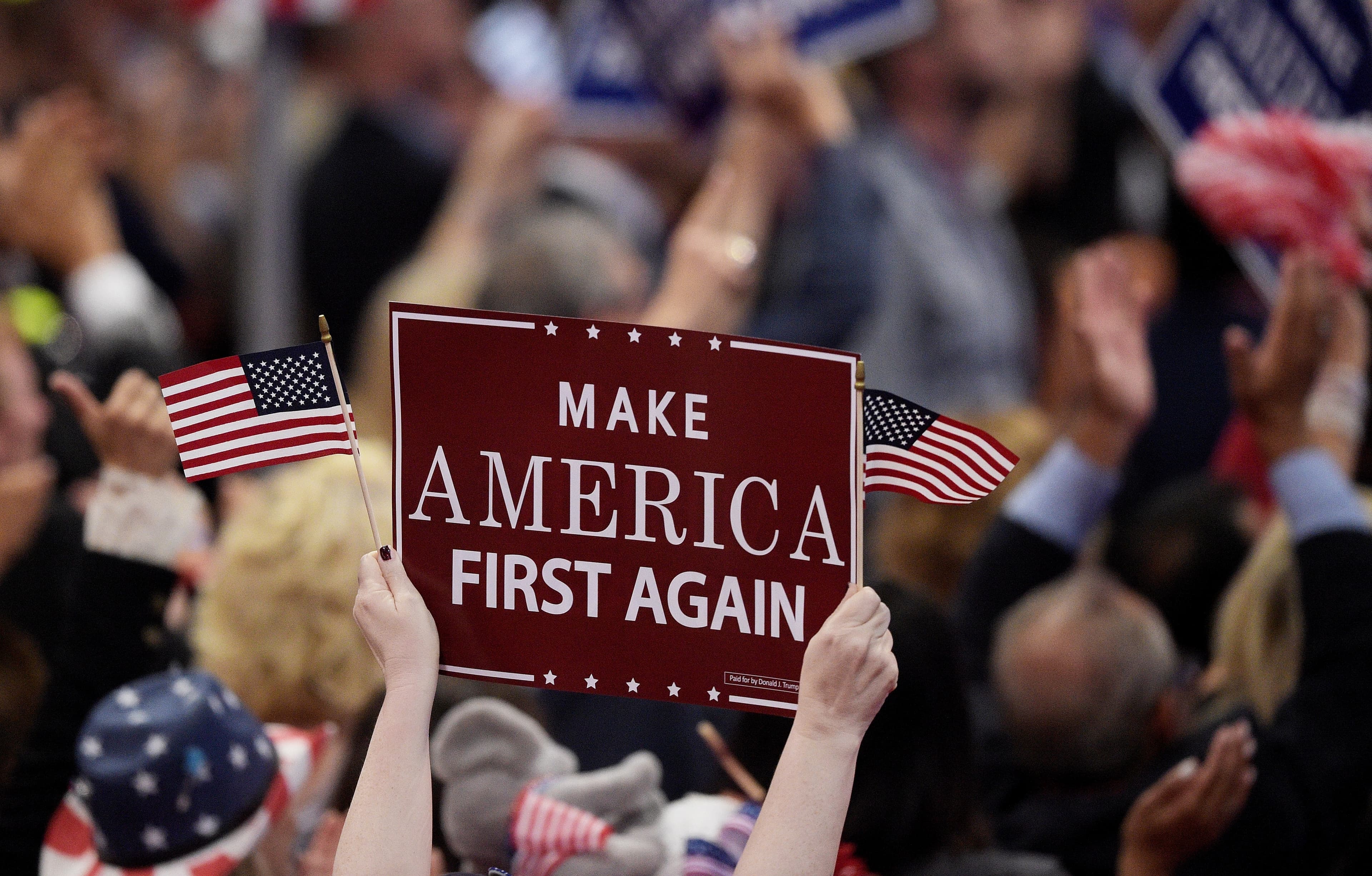
Even if Venezuela were militarily conquerable, the American public shows little appetite for conquering it. Secretary of State Marco Rubio has made regime change his signature cause. The coalition that elected Donald Trump has not.
Rubio represents a specific tradition within Republican foreign policy. For him, Venezuela is unfinished business, a project he has pursued for over a decade. He views Maduro not merely as a dictator but as a linchpin in a broader axis that includes Cuba, Nicaragua, and increasingly Russia and China. Removing Maduro, in his framing would cascade into regime weakness across the hemisphere. Rubio has consolidated unusual power to pursue this vision, holding both the State Department and the National Security Council. The FTO designation, the military buildup, the Noriega comparisons: these bear his fingerprints.
The question is whether he has a country behind him. The evidence suggests he does not. Polling shows roughly 30 percent of Americans support military action in Venezuela, with seven in ten opposed. Even among Republicans, where a slim majority would back military action, virtually none rank Venezuela among their top concerns.
“Even if Venezuela were militarily conquerable, the American public shows little appetite for conquering it. Secretary of State Marco Rubio has made regime change his signature cause. The coalition that elected Donald Trump has not.”
What voters care about is inflation, immigration, and crime. They are watching grocery prices climb and mortgage rates squeeze household budgets. Venezuela registers nowhere on this list. Rubio is waging a campaign to reshape the Western Hemisphere for a public that cannot locate Venezuela on a map.
The disconnect runs deeper than indifference. The coalition that elected Trump was defined in part by exhaustion with foreign intervention. These voters remember Iraq: the weapons that did not exist, the trillion dollars spent, the 4,500 American lives lost. They remember Afghanistan: twenty years, two trillion dollars, a collapse measured in days. They did not sign up for another war to install a government most of them have never heard of. Trump understood this when he campaigned against “forever wars”. His voters believed him. Now they watch his second term feature talk of Greenland, the Panama Canal, and Venezuela. The gap between promise and practice is becoming difficult to ignore.
This is the political ceiling any intervention would hit. An air campaign might hold attention for a week. But the Venezuelan defences mean aircraft would be lost. Pilots would be killed or captured. And a prolonged occupation, the kind the colectivos and Plan Zamora are designed to produce, would face the same erosion of support that doomed Iraq. Public opinion does not stay high. It bleeds out with every casualty, every inconclusive month, every press conference where officials cannot explain what victory looks like.
This leaves policy suspended between threat and action. The military assets sit in the Caribbean. The rhetoric remains bellicose. But the coalition for sustained war does not exist. Rubio has the tools for escalation. He lacks the public mandate to use them.
The Longer Game
If an invasion is impractical and the political will for sustained war does not exist, what options remain? The honest answer is: none that are quick, none that are clean, and none that guarantee success. History demonstrates that authoritarian regimes can fall without foreign armies, but the path is measured in years, not days. Chile transitioned from Pinochet. Poland escaped communism. South Africa ended apartheid. Each required years, compromise, and distasteful bargains with guilty men. None delivered perfect justice. All delivered functional democracy.
Venezuela’s path will demand the same patience. What follows is a framework for what a realistic transition strategy could look like and what it would require.
Untangling the Military from the State
Venezuela’s military is not a separate institution that might step aside as Chile’s eventually did. It is fused with the ruling party through control of ministries, state enterprises, and illegal mining operations. Senior officers receive direct economic benefits from regime survival. The colectivos provide a parallel security apparatus embedded in civilian neighbourhoods. Cuban intelligence trains and monitors Venezuelan security forces, creating an external guarantor for loyalty.
This fusion means that threatening military leaders with prosecution welds them to Maduro rather than separating them from him. The FTO designation achieved precisely this: by declaring senior commanders members of a terrorist organisation, Washington eliminated any incentive to defect.
The policy correction is straightforward if unpalatable. The United States must create a credible pathway for military figures to exit the regime without facing extradition. This means amnesty frameworks for those not directly implicated in atrocities, guarantees that military pensions will be honoured under a successor government, and institutional roles for officers in a reformed security structure. South Africa integrated apartheid-era military officers into a new national defence force rather than purging them. Poland guaranteed Communist Party members seats in the transitional parliament. Neither compromise was morally satisfying. Both prevented civil war.
A tiered approach would distinguish between Maduro’s inner circle and the broader officer corps. Mid-level commanders are not ideologues. Their loyalty is transactional, based on resource access and personal safety. Offer them a future, and regime cohesion becomes less certain.
Sanctions as Conditional Leverage
The first Trump administration’s maximum pressure campaign proved that sanctions alone cannot topple the regime. Despite reducing oil revenues from $40 billion in 2013 to $2 billion by 2020, Maduro survived by rerouting exports to China, Russia, and Iran. Sanctions without diplomatic off-ramps empowered adversaries while inflicting humanitarian harm that the regime weaponised for nationalist propaganda.
The lesson is not that sanctions fail but that they must function as leverage rather than punishment. Leverage requires conditionality: concrete steps the regime can take to receive concrete relief.
-
Policy should shift towards targeted, conditional sanctions with clear benchmarks:
-
Release of all political prisoners, currently numbering over 170, earns partial relief.
-
Restoration of opposition political rights, including lifting Machado’s disqualification, earns further concessions.
-
Appointment of an independent electoral council with opposition and civil society representation unlocks oil sector licences for Western firms.
-
Military withdrawal from illegal mining operations triggers additional economic normalisation
Each benchmark must be verifiable, and backsliding must trigger automatic snapback provisions. The Biden administration experimented with conditional relief during the 2023 Barbados talks. Maduro pocketed concessions and broke commitments because there were no consequences for cheating. Future conditionality must include enforcement mechanisms.
Humanitarian carve-outs are equally essential. Sanctions must explicitly exempt food, medicine, and remittances to prevent the regime from weaponising civilian suffering. Maximum pressure without humanitarian exceptions hands Maduro a narrative of external aggression.
Analysts estimate that calibrated sanctions could yield transition within three to seven years by creating exit incentives rather than survival imperatives.
Machado as Moral Centre, Not Sole Leader
María Corina Machado provides what the opposition has long lacked: a unifying figure with international legitimacy. Her Nobel Prize recognised her transformation from opposition radical to democratic symbol. Her July 2024 campaign proved that Venezuelans will vote against Maduro by overwhelming margins when given the chance.
But Machado is banned from holding office and lives in hiding. Her role is moral leadership and international advocacy, not day-to-day governance. More importantly, her platform offers little to Chavistas beyond implied accountability, which regime figures hear as retribution. Her manifesto speaks of justice but not reconciliation.
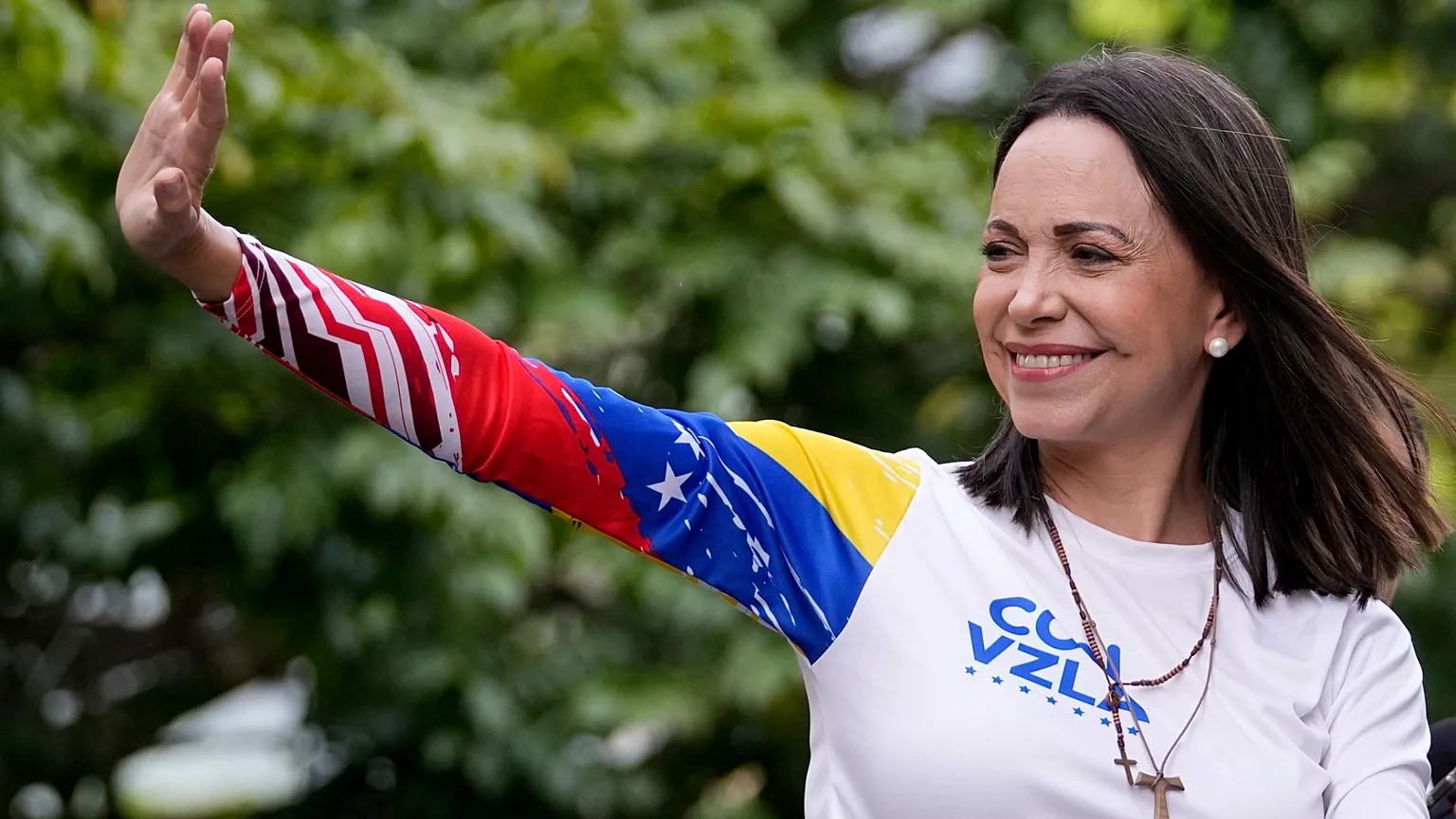
A successful transition requires division of labour. Machado should remain the international face of democratic legitimacy, the figure who mobilises diaspora support and maintains pressure from Western capitals. But a separate channel must engage regime moderates, military pragmatists, and Chavista civil society. Edmundo González, the nominal election winner now in Spanish exile, could serve this role. So could a defecting general willing to negotiate institutional arrangements.
The opposition must also address its own fragmentation. Some parties participated in May 2025 legislative elections despite boycott calls. Machado must maintain coalition unity without formal authority. This requires tolerating tactical disagreements while holding firm on non-negotiable demands: free elections, independent institutions, and civilian control of the military.
Maduro’s Exit
Maduro may wrap himself in revolutionary rhetoric, but his behaviour suggests a pragmatic survivalist. He agreed to the 2023 Barbados talks when sanctions pressure peaked, then reneged when pressure eased. This pattern reveals his decision-making calculus: he responds to leverage, not goodwill.
His red lines are equally clear. He will not accept anything threatening his personal safety, his wealth, or trials before international courts. Any transition framework must offer him a dignified exit: exile with immunity, or domestic retirement with guarantees against prosecution.
This is distasteful. Maduro has overseen systematic repression, economic collapse, and the displacement of seven million Venezuelans. Justice would demand accountability. But the choice is not between justice and injustice. It is between imperfect transition and indefinite dictatorship. Chile’s opposition accepted that Pinochet would never face trial. The alternative was continued military rule.
Policy should present Maduro with a clear choice: gradual, negotiated exit with safeguards, or eventual collapse with no guarantees. The stick is continued isolation and economic strangulation. The carrot is departure with dignity. Neither alone is sufficient. Both together create the pressure and the pathway.
Neutralising Russia, Co-opting China
External powers complicate but do not determine Venezuela’s future.
Russia’s involvement is strategic rather than economic. The S-300 air defence systems, the Su-30 fighters, the military advisors: these exist to project influence and irritate Washington, not to generate revenue. Moscow is unlikely to support democratic transition voluntarily and may actively sabotage negotiations to preserve its Caribbean foothold.
The goal with Russia should be containment, not cooperation. Secondary sanctions on Russian firms operating in Venezuela could limit their role. Diplomatic messaging should make clear that a democratic Venezuela will not tolerate foreign military installations. But direct confrontation risks escalation that serves no one’s interests. The pragmatic approach is negotiating around Russian presence rather than demanding its removal as a precondition.
China presents different opportunities. Beijing has loaned Venezuela over $60 billion and remains its largest oil customer. Chinese interests are transactional: debt repayment, continued oil access, and preventing American hegemony in Latin America. Unlike Russia, China has no ideological commitment to Maduro’s survival.
Policy should offer China a stake in transition. Privileged creditor status in any debt restructuring. Guaranteed oil contracts under a democratic government. Continued market access for Chinese firms willing to operate transparently. In exchange, Beijing pressures Maduro to negotiate seriously and withholds the loans and spare parts that keep his military functional. China prefers stability to chaos. A negotiated transition offers more stability than indefinite confrontation.
Governing the Resource Curse
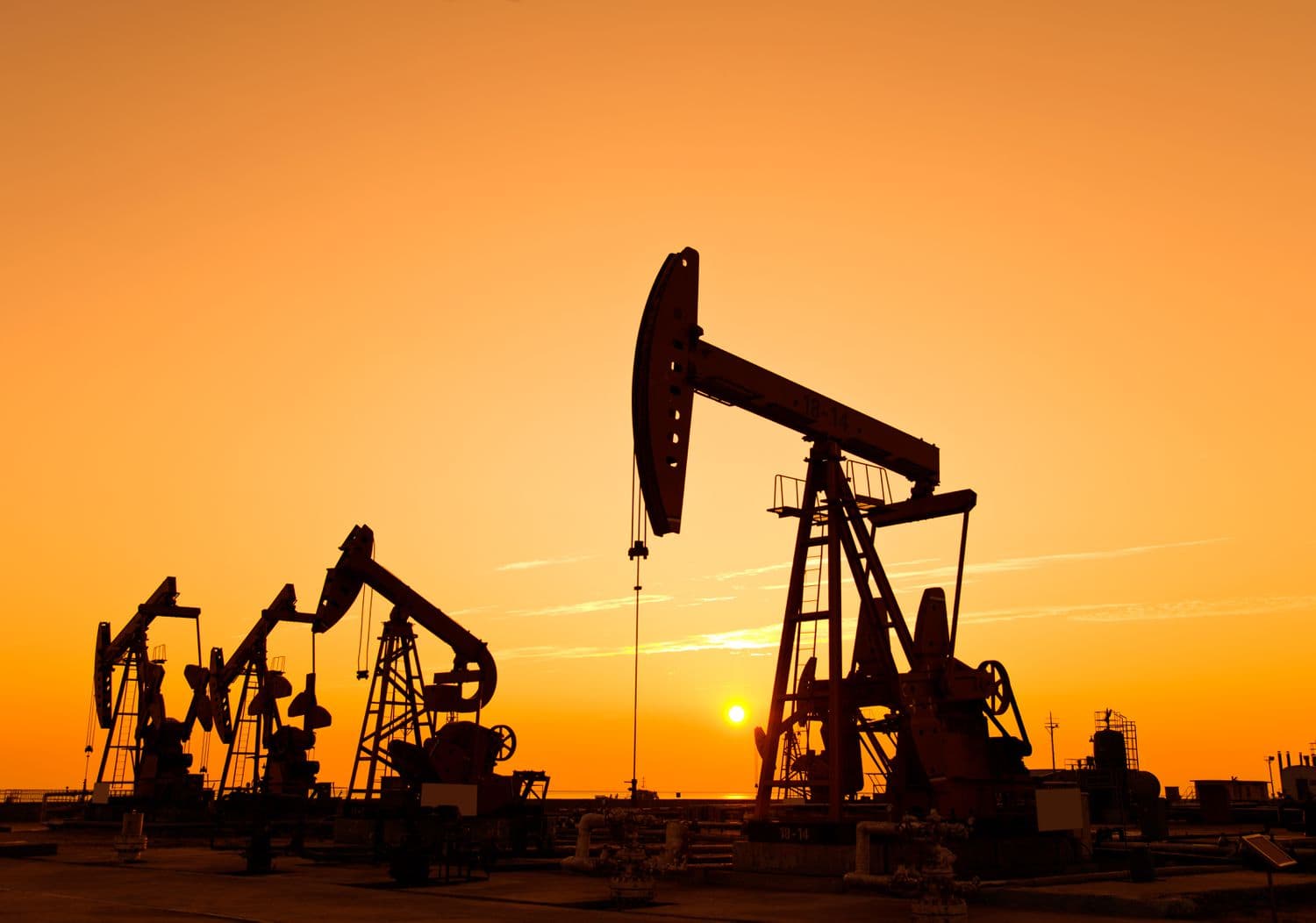
Venezuela possesses 303 billion barrels of proven oil reserves, the world’s largest, plus vast deposits of gold, coltan, and rare earth minerals valued at $1.7 trillion. These resources could fund reconstruction and attract the foreign capital a post-Maduro government would desperately need. They also sustain the patronage networks that keep the regime alive.
The government converts resource wealth into loyalty. The military controls PDVSA, the state oil company, and dominates the mining sector. Food distribution runs through clientelist networks. Elites park their cuts in offshore accounts. These structures would not disappear with Maduro.
A transition strategy must address resources in phases:
Immediate transparency: Audit all state energy and mining assets within the first hundred days. Publish contracts with Chinese and Russian firms. Expose the financial architecture of regime corruption.
Short-term displacement: Issue transparent licences to Western firms like Chevron, Exxon, and Total to displace adversary influence and restore production capacity.
Medium-term institutionalisation: Create a sovereign wealth fund modelled on Norway’s, with parliamentary oversight and citizen dividends. This breaks the direct link between resource revenues and executive patronage.
Long-term diversification: Invest in infrastructure and technology to reduce dependence on extractive industries and escape the resource curse that has distorted Venezuelan politics for a century.
A democratic Venezuela could become an energy security partner for the United States and Europe, reducing reliance on Gulf states and challenging Chinese and Russian influence across Latin America. But this requires governance structures that prevent any future president from capturing resource wealth for political purposes.
Constitutional and Institutional Reform
Venezuela’s 1999 constitution, written under Hugo Chávez, centralises power in the presidency and enables authoritarianism. It removed term limits, allowing indefinite rule. It permits simple majorities to pack the Supreme Court. It authorises constituent assemblies that bypass the elected National Assembly. Any durable transition must rewrite these rules.
Transitional provisions in the first two years should restore pre-1999 term limits, limiting presidents to one six-year term with no consecutive re-election. An independent electoral council must be created with opposition and civil society representation. A transitional justice mechanism should establish a truth commission with conditional amnesty for those who cooperate and did not commit atrocities.
Permanent reforms over the following three to five years should federalise political power, empowering states and municipalities to reduce presidential control. An independent judiciary requires lifetime appointments with impeachment protections. Autonomous prosecutor general and comptroller offices must be constitutionally protected. Military neutrality in politics should be enshrined in the constitutional text.
Resource governance deserves its own constitutional clause: a sovereign wealth fund with parliamentary oversight, transparent bidding for mining concessions, and environmental and indigenous rights protections.
Constitutional reform requires public referendum and legislative supermajorities, a process taking two to five years minimum. A transitional charter could be implemented faster through negotiated decree, providing interim rules while permanent institutions are built.
The Timeline
Realistic transitions unfold over years, not months. If the strategy outlined here were implemented, a reasonable trajectory would span three to seven years.
In the first phase, a mix of targeted sanctions and credible offers of relief makes continued stonewalling more costly than limited concessions. Political prisoners begin to be released. Some opposition rights are restored. Under heavy external and regional pressure, a more independent electoral council emerges. Even this modest repositioning could take one to two years—and longer if the regime believes it can outlast international attention.
In the second phase, a transitional government with shared power emerges from these negotiations. Over roughly two to three years, it organises competitive elections, lifts key bans such as Machado’s disqualification, and begins cautious security-sector reform. In practice, each of these steps risks deadlock, sabotage, or relapse into repression.
In the final phase, permanent institutions consolidate. A sovereign wealth fund is established. The judiciary achieves independence. The military withdraws fully from politics. Each reform will be contested. Each institution will be tested. By the time these institutions begin to behave predictably, the transition will be measured not in presidential terms, but in school cohorts and exile generations.
None of this is guaranteed. Maduro may still conclude that resistance is cheaper than concession. International attention may drift to the next crisis. The opposition may split under the strain of compromise. But the absence of guarantees is not an argument for passivity. It is an argument for political endurance, domestic and international, that outlasts the regime’s bet on fatigue.
The Choice
None of this is satisfying. It offers no dramatic victory, no liberation footage, no moment when justice is visibly done. It requires patience measured in years, compromise with people who deserve punishment, and acceptance that strategic success may look nothing like moral triumph.
But it has one advantage over the Panama fantasy: it might actually work. The alternative is a policy suspended indefinitely between threat and action—a military buildup that achieves nothing and an opposition leader in hiding, waiting for a rescue that never comes.
We know the United States can force a regime change. The question is: Can it endure the peace? Can it support a transition that is undeniably messy and lacking in true justice, provided that it delivers a democracy that actually works?
History suggests that half a democratic loaf is better than none—especially if the alternative is civil war or permanent autocracy.
Conclusion
The ships remain in the Caribbean. The legal designations accumulate. The rhetoric sharpens. None of it changes the underlying arithmetic.
Venezuela is not Panama. It is a country twelve times larger, defended by Russian missiles and Cuban intelligence, governed by a regime that watched the 2002 coup fail and spent two decades ensuring the next one would fail too. The invasion that Rubio’s analogies imply would not be minor surgery. It would be a war measured in years and casualties, fought in mountain passes and urban barrios, against an enemy that has planned for nothing else.
What remains is the slower path: conditional leverage, negotiated exits, institutional reform, and the patience to accept that durable change unfolds over years, not news cycles. This demands a consistency that American politics rarely sustains and compromises that justice rarely forgives.
Machado placed her bet when she dedicated that Nobel Prize. She needs external pressure to break the regime’s grip. But pressure without strategy is theatre. And theatre alone will not topple a regime.
The question is whether Washington can tell the difference between strategy and theatre.