Modern democracies frequently fail to represent their citizens' true interests, prompting us to look for innovative solutions. Perhaps we can find inspiration not in traditional political systems, but in an unexpected place: the open-source communities that quietly shape our digital world.
I've watched thousands of strangers collaborate to build the software that powers our modern world. They work across continents and time zones, resolve conflicts through transparent processes, and create complex systems that no single person or company could achieve alone. It's called open source development, where anyone can contribute code, suggest improvements, and help debug problems. The results speak for themselves: this collaborative model is used by over 90% of Fortune 500 companies and runs everything from your smartphone to the world's largest websites.
When I read Glen Weyl and Audrey Tang's book Plurality: The Future of Collaborative Technology and Democracy, their vision immediately resonated. What if we could apply these same principles to democracy itself? What if citizens could contribute to policy-making like developers contribute to code? What if we had transparent processes for resolving political conflicts? What if we could debug democracy the same way we debug software?
Democracy: A Foundation in Participation
At its core, democracy means rule by the people, a simple principle rooted in the idea that each person's interests deserve equal consideration and that the aggregate of these voices should dictate political direction. This principle depends entirely on meaningful participation. It's the breadth and depth of citizen participation that's the true measure of a democracy.
Yet modern democracies systematically fail this test. In the UK, only 22% of respondents believe elected representatives care about people like them. I think we can all relate to this misalignment between the will of the people and the will of those in power.
The evidence is stark: 83% of Americans support Medicare drug price negotiations and 85% favor universal background checks, yet these issues remain political landmines trapped in partisan gridlock. These aren't partisan issues. They're democratic failures. When supermajorities spanning political divides cannot achieve basic policy goals, the system itself becomes suspect.
The representation gap between public opinion and policy outcomes reveals structural problems that voting alone cannot solve. If democracy means government by the people, then a system where overwhelming majorities consistently fail to translate their preferences into policy fails that basic test.
Traditional democratic systems offer citizens remarkably few opportunities for meaningful participation beyond casting ballots every few years. We vote for representatives, then largely disappear from the political process until the next election cycle. This episodic engagement stands in stark contrast to what political theorists call deliberative democracy, which envisions citizens as active participants in ongoing policy conversations.
Deliberative democracy requires more than just voting. It demands informed discussion, careful consideration of trade-offs, and genuine dialogue across different perspectives. When citizens are given time, information, and structured opportunities to discuss complex issues, their preferences often shift toward more nuanced, workable solutions. Yet our current institutions provide almost no space for such deliberation.
The challenge is how to scale up meaningful deliberation and involvement in an era when societies are large and complex. This is where lessons from the tech world, especially the open-source movement, become invaluable.

Software’s Democratic DNA
Open source software operates on principles that mirror democratic ideals: transparency, inclusion, meritocracy, and continual adaptation. These aren't just abstract concepts, they're proven governance models managing millions of contributors across thousands of projects.
Transparency builds trust and accountability, which lays the foundation for broader inclusion. All discussions and decisions in open-source communities happen in the open. Code changes, bug reports, and debates are visible to anyone. This radical transparency creates what proprietary software cannot: genuine accountability where every decision can be scrutinised and every contributor held responsible for their work.
Inclusion harnesses collective intelligence. Open source projects demonstrate the wisdom of crowds at massive scale. Linux involves over 15,000 developers from 1,400 companies across six continents. Apache HTTP Server, powering nearly 25% of all websites, results from thousands of voluntary contributors who've never met face-to-face. These projects achieve complexity and reliability that no single organisation could match.
Meritocracy rewards contribution over credentials. In open source development, your university degree or job title means nothing, only the quality of your code matters. A teenager in Bangladesh can propose changes that reshape software used by Fortune 500 companies. Those who invest more effort and demonstrate greater ability naturally gain more influence, creating leadership structures based on competence rather than hierarchy.
Adaptation through forking empowers democratic choice. If you disagree with a project’s direction, you can “fork” it—copy the code and develop a new version. This ensures alternatives always exist, allowing software to evolve locally while preserving the original for those who prefer it.
Eric Raymond, a prominent open-source advocate, highlighted in his seminal 1997 essay “The Cathedral and the Bazaar” why this distributed model works:
“Given a large enough beta-tester and co-developer base, almost every problem will be characterised quickly and the fix obvious to someone”
This principle, that distributed intelligence outperforms centralised control, applies equally to democratic governance.
What seemed utopian decades ago has now become reality in Taiwan, where the g0v (gov-zero) movement literally “forks” government websites and services, creating transparent and community-driven alternatives. Citizens directly collaborate to build these solutions, effectively coding improvements into their own democracy. Taiwan's civic innovations demonstrate the real-world potential of open-source governance and suggest how emerging AI technologies could further amplify citizen voices.
Taiwan Transforms Democracy Through Civic Hacking
Taiwan’s journey from authoritarian rule to digital democracy pioneer began with trauma and hope. After 38 years of martial law ended in 1987, citizens who had fought for democracy refused to accept its limitations.
When the 2014 Sunflower Movement occupied the Parliament to protest a trade deal with China, the Taiwanese political system proved resilient enough to accommodate their demands for greater transparency and deliberative democracy. The movement's success in blocking the trade deal and changing political discourse laid the groundwork for the civic technology innovations that followed. This pivotal moment in Taiwan’s democratic evolution set the stage for a wave of innovative civic technology experiments.
Out of this protest, new institutions were born. One is vTaiwan, a platform run by volunteers in collaboration with government ministries that revolutionised policy-making through structured online deliberation. The platform follows a four stage process: proposal, opinion collection using Pol.is, face-to-face reflection and policy realisation. The magic lies in Pol.is, a large scale online deliberation platform that enables thousands of people to participate in structured discussions. What’s unique to Pol.is is that the participants cannot attack each other or reply to an opinion but merely agree, disagree or pass. This prevents escalation and keeps the focus on ideas rather than arguments. Machine Learning algorithms identify opinion clusters and surface bridge statements. A visual interface shows participants how their views relate to others.
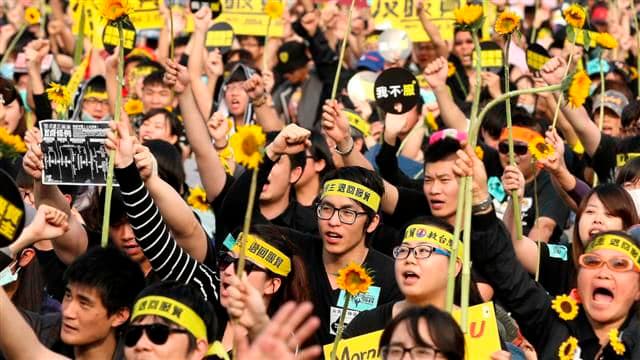
The results in Taiwan have been powerful. The country has avoided the extreme polarisation seen elsewhere, even on contentious issues, in part because these digital forums allow diverse views to be heard and integrated. Rigid ideology can often deepen division, but open dialogue can highlight common values and foster unity.
The Pol.is experience reveals that even if two groups differ strongly on a few issues, they might unexpectedly agree on many others, those points of agreement become the basis for consensus policy. By embracing openness and technology, Taiwan has built one of the world’s most participatory democracies. Citizens feel heard, and policies enjoy broad public support.
The next Revolution in Democratic Participation
Open source platforms like Pol.is, represent just the beginning of AI's democratic potential. While these systems rely on traditional machine learning techniques that now seem distant from today's AI frontier, they've proven the concept: artificial intelligence can facilitate consensus at scale. Recent research confirms this potential at even larger scales. Google DeepMind's 2024 "Habermas Machine" study with 5,734 participants demonstrated that AI mediators outperform humans at facilitating democratic consensus, with 56% of participants preferring AI-generated statements for their clarity and lack of bias.
But consensus-building through information clustering represents only the first step in democracy's AI transformation. Advanced technologies like reinforcement learning, where systems learn through continuous trial-and-error interactions and multimodal large language models promise to accelerate and enhance deliberation processes far beyond current capabilities. However, the most revolutionary potential emerges at the intersection of advanced AI and personalised democratic participation.
At their recent Developer Conferences both Satya Nadella and Sundar Pichai each articulated their vision for personalised artificial intelligence that acts as a deeply personal assistant. A system with access to your calendar, medical history, preferences, communication patterns, and ultimately maybe your political values. These AI’s learn continuously from your decisions while accessing real-world information, distilling knowledge specifically for your context and worldview.
This raises a profound possibility: What if your personal AI could participate in political deliberation on your behalf?
Imagine this: your AI knows you care about climate action but also worry about its impact on working families. In a carbon tax debate, it might suggest a revenue-neutral plan with targeted rebates—a position that reflects your values better than any binary vote. Now multiply that by millions: AI delegates continuously deliberate, each representing a citizen’s perspective, processing vast information, and building consensus at unprecedented scale.
This isn't science fiction. The technological components already exist. The question is whether we should build it.
Try It: A Pol.is-Style Deliberation
1 / 6
“Voting should be mandatory for all citizens”
Vote on each statement to see where you land in the opinion landscape. Simulated clusters represent common viewpoints from the essay's themes.
The Democratic Dilemma: Convenience vs. Citizenship
At its heart, this dilemma is about choosing between efficiency and active citizenship, between convenient outcomes and the often messy process of democratic engagement. Democracy has always demanded more than just outcomes; it requires active engagement in the civic process. When we delegate our political voice to AI, even AI that perfectly represents our views, do we risk losing something essential about citizenship?
I do wrestle with the stakes here. People have sacrificed their lives fighting for the right to vote. Across the globe, citizens risk imprisonment simply for democratic participation. Civil rights activists and pro-democracy movements worldwide didn't just fight for the right to influence policy, they fought for the right to participate in shaping their collective future.
Can we so casually delegate this responsibility to artificial intelligence, no matter how sophisticated?
We've already delegated many tasks that once required human judgment, from medical diagnoses to investment decisions. Yet political participation feels fundamentally different. Unlike medical diagnoses or investment decisions, political participation isn’t merely about optimising outcomes. It’s fundamentally about collective values, moral judgments, and social responsibility.
I remain a techno-optimist and with eyes wide open. The current system demonstrably fails to translate citizen preferences into policy. If AI delegation provided every citizen with a tireless advocate who genuinely reflected their nuanced views, wouldn’t this enhance democratic representation rather than diminish it.
Risks and Safeguards in an AI-Mediated Democracy
The risks are as significant as the potential benefits. AI alignment remains an unsolved challenge of staggering complexity. At its core, alignment ensures AI systems genuinely reflect human values rather than optimising unintended or harmful goals. Even perfectly aligned systems face threats from bias in training data, foreign manipulation, and sophisticated hacking attempts that could compromise democratic legitimacy.
Consider the practical vulnerabilities: How would we verify that AI delegates genuinely represent their humans rather than hidden interests? What prevents wealthy actors from deploying more sophisticated AIs that dominate deliberation? How do we handle inevitable disagreements between humans and their AI representatives?
Addressing these vulnerabilities requires thoughtful safeguards, particularly through transparent and collaborative governance. The answer might lie in applying open source principles to AI democracy itself. Transparent algorithms, auditable decision-making processes, and community oversight could help ensure these systems serve democratic rather than authoritarian ends. Just as open source software thrives through collaborative verification, AI-mediated democracy might require similar transparency and collective governance.
The choice isn't whether AI will transform democracy. The question is whether we can guide it wisely, preserving democracy's essential human elements while harnessing technology's power to make collective decision-making more responsive, inclusive, and effective.
Taiwan showed us that civic technology can rebuild trust and enhance participation. The next chapter may determine whether we can achieve democracy's full potential or risk losing its essence in pursuit of efficiency. As with all powerful technologies, the outcome depends entirely on how we choose to wield it.
Final Thoughts
Beneath these practical concerns and potential opportunities lies a deeper philosophical question: What does it mean to be human? If we delegate thinking to AI assistants, writing to language models, work to automation, and now voting to digital representatives, what essentially human activities remain?
Are we optimising ourselves out of our own lives in the relentless pursuit of efficiency, sacrificing creativity, spontaneity, and authentic human connection along the way? Or might this shift instead open space for deeper engagement in uniquely human experiences we have yet to fully explore?
I remain optimistic.